The Perpetual Telegram
By Darrell Lee
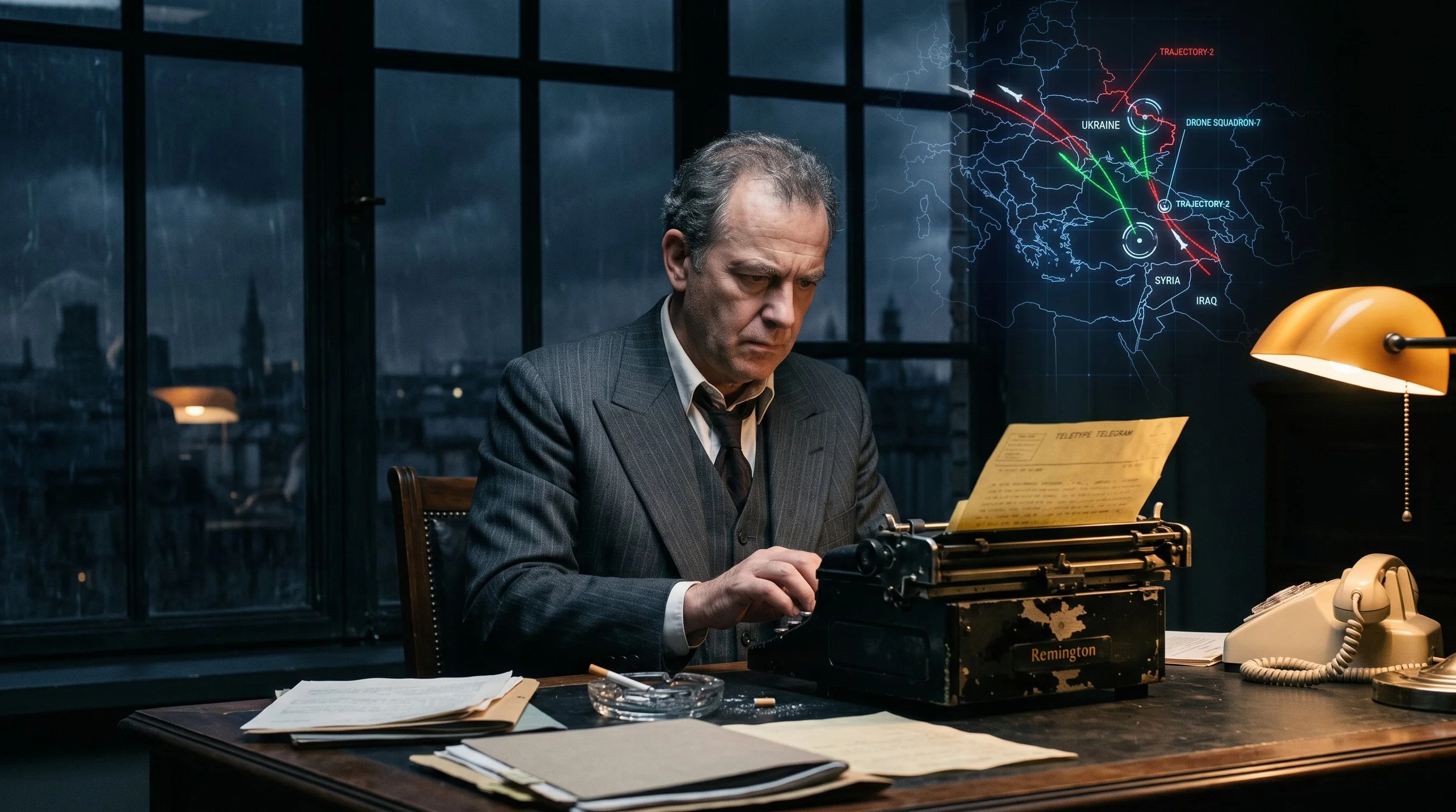
The Echoes of Total War
In the late summer of 2026, the sky above Eastern Europe has ceased to be a passive expanse and has become the primary arena of a grinding, bare-knuckle war of attrition. Four years after Vladimir Putin launched his full-scale invasion of Ukraine, the conflict has settled into a harrowing, symmetrical bludgeoning. In Kyiv, Iskander-M ballistic missiles shatter schools, residential blocks, and children’s hospitals, exploiting a lethal shortage of Western Patriot interceptors—a scarcity exacerbated by expanding geopolitical fires in the Middle East. In response, Ukrainian deep-strike drones reach hundreds of miles into the Russian heartland, setting ablaze major oil refineries in Nizhny Novgorod, striking shipping in the Black Sea, and burning e-commerce logistical hubs in Tambov.
Both sides operate on a shared, flawed military premise: that sufficient physical pain will eventually force political capitulation. Moscow bets that plunging Ukrainian cities into darkness, cold, and terror will break the civilian spirit. Kyiv bets that destroying the economic apparatus funding Russia’s war machine will compel the Kremlin elite or a weary public to demand a halt. Yet, as military history repeatedly demonstrates, strategic bombardment almost universally hardens societal resolve rather than shattering it. The war grows exponentially more ruthless, yet remains no closer to a conclusion.
This strategic impasse illustrates a shortsightedness in modern Western statecraft—a failure to understand the fundamental nature of the Russian state, the psychological drivers of its leaders, and the historical warnings that politicians consistently ignore. To understand why coercive terror fails against Kyiv, and why transactional deterrence repeatedly misses the mark in Moscow, one must return to February 1946, when a 5,500-word cable dispatched from an embassy desk in Moscow reshaped Western grand strategy.
From Imperial Russia to Putin’s Desire to Expand
The tragedy of the current war lies not merely in its tactical brutality, but in its historical predictability. As explored in Putin, Ukraine, and History's Unheeded Warnings, modern Western statecraft has struggled to recognize that revisionist autocracies do not view the international order through economic cost-benefit analysis. They view it with a sense of historical destiny, territorial revisionism, and imperial survival. When Vladimir Putin laid the ideological groundwork for the invasion of Ukraine—frequently invoking Catherine the Great, Peter the Great, and the alleged "historical unity" of Russians and Ukrainians—Western observers dismissed his rhetoric as mere political posturing or performative nationalism intended for domestic consumption. This was a miscalculation. History offers ample warning: when authoritarian leaders explicitly publish their imperial ambitions, take them at face value.
The annexation of Crimea in 2014 and the invasion of Georgia in 2008 were not isolated, situational crises; they were incremental steps in a long-term strategy. Much like European powers in the late 1930s mistook incremental territorial demands for finite, negotiable claims, modern Western policy consistently treated each Russian provocation as a distinct event the West could manage through localized diplomacy or targeted sanctions. By ignoring these historical precedents, the West repeatedly misjudged the Kremlin’s willingness to absorb immense material costs in pursuit of imperial restoration. When statecraft forgets the structural continuity between Tsarist autocracy, Soviet totalitarianism, and post-Soviet kleptocracy, it inevitably falls into the trap of assuming that traditional economic or political disincentives can deter modern autocrats.
Five Thousand Words to Wake the West
In 1945, amidst the aftermath of World War II, Secretary of the Navy James Forrestal posed a fundamental question that would define the post-WWII order: In dealing with the Soviet Union, was Washington confronting a conventional nation-state driven by standard geopolitical interests, or a religious movement bound to an unyielding ideology?
The answer arrived on February 22, 1946. George F. Kennan, then the 42-year-old deputy chief of mission at the U.S. Embassy in Moscow, was recovering from a cold when a routine query arrived from the Treasury Department asking why the Soviets were refusing to join the newly created World Bank and International Monetary Fund. Kennan, a scholar of Russian history who read Pushkin and Chekhov in the original, realized that Washington completely misunderstood its wartime ally. Diplomatic protocol strictly forbade dictionary-length cables, but Kennan dictated a monumental, five-part analysis that shattered Washington's illusions. At its core, "The Long Telegram" argued that Soviet neuroses were not merely a product of Marxist-Leninist dogma, but the modern manifestation of a traditional, centuries-old Russian sense of insecurity.
"At bottom of Kremlin's neurotic view of world affairs is traditional and instinctive Russian sense of insecurity," Kennan wrote. This insecurity was born of a vast, agricultural population living on a flat, defenseless plain, historically ruled by autocratic regimes that learned to seek legitimacy only by depicting the outside world as inherently hostile and threats as existential.
Kennan’s most crucial insight was operational:
The Soviet regime was impervious to the logic of reason, making diplomatic compromise for its own sake virtually impossible.
The Kremlin was highly sensitive to the logic of force. It would not take unnecessary risks; when confronted by unyielding, well-organized resistance at any point, it would readily back down and retreat.
This telegram became the intellectual foundation for the policy of containment, later articulated publicly in Kennan’s 1947 Foreign Affairs essay. Kennan argued that the United States did not need to launch a catastrophic war to defeat the Soviet Union, nor could it rely on naive diplomacy. Instead, it required a long-term, patient, firm, and vigilant containment of Russian expansive tendencies, waiting for the internal contradictions of the autocratic system to cause its eventual decay.
The Misunderstood Mind of the Kremlin: 1946 vs. 2026
Eight decades later, the Trump administration's handling of the war in Ukraine reveals both a faint echo and a distortion of Kennan’s core doctrine. When CIA Director John Ratcliffe made a secretive, urgent trip to Moscow last week to warn Russian intelligence against launching a limited assault or cyber-offensive on a NATO Baltic state, Washington was attempting a modern exercise in Kennan-style line-drawing. Following intelligence assessments that Putin, squeezed in Ukraine, might test NATO's Article 5 resolve, the United States signaled that an expansion of the war beyond Ukraine would encounter direct counter-force. Yet, contemporary U.S. policy continually strays from Kennan’s deeper warnings—and the historical lessons outlined in History's Unheeded Warnings—in three critical ways:
First, modern Western statecraft routinely treats Vladimir Putin as a transactional actor who can be coaxed into a durable peace through economic pressure or brief diplomatic overtures. President Trump’s characterization of high-level diplomatic trips as "semi-routine" attempts to "get that war ended" reflects a persistent American belief that complex geopolitical conflicts can be solved with a quick deal. Kennan explicitly warned that Russian leadership operates on a totally different temporal plane. The Kremlin views international relations not as a series of win-win transactions, but as a permanent, zero-sum struggle between incompatible political systems. When Western diplomats approach the Kremlin with transactional mindsets, Moscow interprets it not as goodwill, but as structural exhaustion and weakness.
Second, the strategic bombing campaigns waged by both sides reflect a misunderstanding of autocratic durability. Putin’s "strategy of pain"—destroying Ukrainian energy, water, and civil infrastructure—assumes that democratic societies operate under a fragile social contract that snaps under physical duress. As military analyst Franz-Stefan Gady observed in the Wall Street Journal article, "The Russia-Ukraine Air War Has Entered a New, Deadlier Phase," a century of strategic bombing demonstrates that sustained air attack hardens societies rather than breaking them. Conversely, Western expectations that deep-strike drone warfare against Russian refineries or domestic supply chains will force Putin to the negotiating table ignore the exact autocratic insulation Kennan identified in 1946. Russia's ruling elite has historically demonstrated a near-bottomless capacity to absorb popular suffering as long as the security apparatus remains intact and the narrative of an existential struggle against Western encirclement is maintained. This analytical blind spot is not unique to Eastern Europe; it is mirrored almost identically in the Middle East.
Third, as sustained U.S. and Israeli air strikes target Iranian naval facilities, energy grids, and transport infrastructure around the Strait of Hormuz—alongside the destruction of key logistical bridges in Bandar Khamir—Washington once again operates under the illusion that infrastructure attrition and economic disruption will force an ideological regime to capitulate.
This is the same analytical failure Kennan diagnosed eighty years ago. Like the Kremlin, the Islamic Republic's ideological apparatus derives its primary legitimacy not from consumer comfort, smooth supply chains, or public popularity. Its identity is anchored in revolutionary anti-imperialism and ideological resistance. Striking refineries or civilian transport networks degrades the national economy, but it does not erode the security elite’s grip on power. The Islamic Revolutionary Guard Corps reallocates dwindling resources to its repressive apparatus while transferring the hardship onto the civilian population. Rather than driving Tehran to seek a quick diplomatic off-ramp, infrastructure strikes incentivize the regime to export the pain regionally—retaliating against Gulf energy facilities, targeting commercial shipping in the Strait of Hormuz, and attacking regional U.S. allies. Just as air strikes fail to break Ukrainian resolve or force Putin to retreat, aerial bombardment against Iranian infrastructure fails to dismantle an ideological state's commitment to its strategic goals. By treating ideological autocracies as fragile corporate entities sensitive to balance-sheet losses, Western strategy continuously confuses economic disruption with political capitulation.
The Fatal Flaw of Modern Deterrence
The crisis of contemporary Western strategy lies in its departure from the clarity Kennan prescribed and the historical lessons of deterrence. Deterrence requires two components: overwhelming capability and absolute credibility. The depletion of Western air-defense stockpiles—driven by competing global demands, including the conflict with Iran—has undermined both. When Kyiv lacks the Patriot missiles needed to intercept Iskanders over its capital, and when Washington must send its intelligence chief to Moscow to verbally reiterate red lines because strategic ambiguity has bred dangerous Kremlin temptation, deterrence is not functioning proactively; it is reacting defensively.
Putin’s warning that Ukraine "opened Pandora’s box" by striking Russian domestic energy infrastructure is a classic piece of Kremlin rhetoric straight out of the 1946 playbook. Autocratic regimes routinely frame their own unprovoked aggression as defensive necessities while framing their victims' defensive responses as unprecedented escalations. By combining the insights of The Long Telegram with the historical lessons of unheeded warnings, several enduring truths emerge.
First, economic sanctions and infrastructure strikes impose genuine costs. Still, they do not alter the fundamental calculations of a regime that views victory in Ukraine—or revolutionary survival in Iran—as a prerequisite for its own existence. Second, aerial terror campaigns almost invariably strengthen national cohesion and opposition to compromise, whether in the targeted neighborhoods of Kyiv or the bombed borderlands of Eastern Europe and the Middle East. Third, autocratic regimes respect only clear, unyielding strength. Hesitation, inventory shortfalls, and political signaling that suggests a desire for "quick exits" only invite further testing of Western boundaries—such as the potential Baltic probing that prompted Ratcliffe's flight to Moscow. Lastly, historically, trying to manage aggression through piecemeal assistance and half-measures fails to deter the aggressor while prolonging the victim's devastation.
Beyond Political Shortsightedness
"The Long Telegram" was not a call for endless war, nor was it a recipe for reckless escalation. It was a plea for intellectual discipline and understanding the historical events driving autocratic behavior. As the air war escalates into an increasingly brutal exchange of long-range destruction across both Europe and the Middle East, the Western alliance stands at a critical juncture. Trying to force a sudden, artificial end to deep-seated conflicts through transactional diplomacy or piecemeal military strikes misses the lesson of the last eighty years. Structural confrontation with autocratic regimes is not a temporary aberration caused by a single leader or political moment; it continues a centuries-old pattern. Confronting it successfully requires what Kennan called "a policy of firm containment, designed to confront the Russians with unalterable counter-force at every point where they show signs of encroaching upon the interests of a peaceful and stable world."
Until Western statecraft grounds its strategy in this historical view—replacing the fleeting hope of quick bargains with the steady, well-resourced discipline of long-term containment—it will remain trapped in the same tragic cycle: reacting to every new covert threat, while history's unheeded warnings continue to manifest in preventable conflict.