The Island Trap
By Darrell Lee
The geopolitical map of the Western Hemisphere contains a single, festering wound. For sixty years, American policymakers have treated the island of Cuba as a nuisance—a relic of the Cold War to be managed with sanctions, travel restrictions, and occasional diplomatic sternness. This passive containment strategy has failed. The critical fuel shortage exacerbated by intensified U.S. pressure signals that the regime in Havana is teetering on the brink of collapse. However, a collapsing regime is often the most dangerous kind. As the Cuban government runs out of fuel and food, it has turned to the only currency it has left: its geography. By leasing its soil to the intelligence services of China and the nuclear navy of Russia, Havana has transformed itself from a failed socialist experiment into a forward operating base for America's most capable adversaries. The time for sanctions is over. The United States must use its military capabilities to physically cut off the island from its patrons and surgically remove a political leadership that has ruined a nation and compromised the security of the hemisphere.
To understand why military isolation is necessary, we must first understand the depth of the intelligence failure. For decades, the American public has been sold the myth that Cuban intelligence is a "junior varsity" operation—a romanticized group of bearded revolutionaries playing at spycraft. The reality is far more sinister. The Cuban Directorate of Intelligence (DGI) is one of the most effective and aggressive espionage organizations in the world. They do not just spy on exiles in Miami; they work inside the Pentagon.
The case of Ana Montes proved that the Cuban government's intelligence penetration had reached the highest levels of the U.S. defense establishment. From 1985 to 2001, Montes served as the Defense Intelligence Agency’s top analyst on Cuba. She was the "Queen of Cuba," the expert who briefed the Joint Chiefs of Staff and the National Security Council. And for every single one of those days, she was a spy for Havana. She passed Top Secret information to her handlers that compromised U.S. military operations in El Salvador and exposed the identities of American officers working undercover. She did not do it for money; she did it for ideology, which made her harder to catch and impossible to buy off. Montes was not an anomaly; she was a prototype.
If Montes was the analyst, Manuel Rocha was the diplomat. In a betrayal that defies belief, Rocha served as the U.S. Ambassador to Bolivia and held senior positions in the National Security Council, all while serving as a covert agent for the DGI for over forty years, beginning in 1981. He was not just a mole; he was a shapeshifter, adopting the persona of a hardline conservative to deflect suspicion while feeding the crown jewels of American diplomacy to a hostile foreign power. The arrest of Rocha in December 2023 revealed the terrifying scope of the failure: the Cuban government had effectively placed a double agent inside the White House situation room. They are acts of war conducted in the shadows.
However, the threat has metastasized beyond mere espionage. In the 20th century, Cuba was a Soviet satellite. In the 21st century, it has become a listening post for the People's Republic of China. Recent intelligence reports have confirmed that Beijing is operating electronic eavesdropping facilities on island bases capable of intercepting communications from the southeastern United States, including the headquarters of U.S. Central Command in Florida. This is a global initiative by the Chinese People’s Liberation Army to expand its military logistics and intelligence network. By allowing China to set up shop ninety miles from Key West, the Cuban regime has effectively granted Beijing a permanent spy base in the Caribbean.
The Russian Federation, too, has returned to its old stomping grounds and, in doing so, has violated the delicate balance that has kept the peace for 60 years. In October 1962, the world stood on the precipice of nuclear annihilation when the United States discovered Soviet ballistic missiles in Cuba. For thirteen terrifying days, President John F. Kennedy and Premier Nikita Khrushchev stared into the abyss. The crisis was resolved only through a tense, informal understanding: the Soviet Union agreed to remove its offensive weapons, and in exchange, Kennedy pledged that the United States would not invade Cuba. This "no-invasion pledge" was not a formal treaty; it was a conditional promise contingent on Cuba remaining free of offensive nuclear capabilities.
In June 2024, the regime in Havana shattered the spirit of that agreement. The Russian nuclear-powered submarine Kazan and the frigate Admiral Gorshkov docked in Havana harbor. This was not a courtesy call; it was a strategic provocation. The Kazan is a modern guided-missile submarine capable of carrying hypersonic Zircon missiles—weapons designed to evade missile defenses and strike American cities in minutes. By hosting a vessel that, for all intents and purposes, is a submerged nuclear silo, the Díaz-Canel regime has voided the 1962 understanding. The immunity from invasion granted by Kennedy was predicated on the absence of such threats. If Cuba insists on hosting the delivery systems of a nuclear adversary, it has forfeited its protection.
While the regime sells its sovereignty to the highest bidder, it has destroyed the nation it claims to protect. The economic vitality of Cuba has been strangled not by the American "blockade," but by sixty years of gross mismanagement, theft, and ideological rigidity. The island's infrastructure is not just aging; it is dissolving. The national power grid has collapsed, plunging millions into darkness for days. The sugar harvest—once the envy of the world—has fallen to levels not seen since the 1900s. The healthcare system, the supposed jewel of the revolution, is a hollow shell where patients must bring their own bedsheets and aspirin.
The internal collapse is accelerating due to a catastrophic energy crisis. Reports indicate that the island has only weeks of fuel remaining, even with draconian rolling blackouts that leave citizens without power for up to 60 hours at a stretch. The situation has been exacerbated by an unprecedented cold spell, with freezing temperatures recorded for the first time in the island's history, catching a populace without heating or adequate resources completely off guard. Officials have informed the public that fuel for private vehicles is no longer available, reserving the remaining diesel for essential state services. The streets of Havana are becoming pedestrian zones by necessity.
This paralysis extends to the most basic human need: food. Under the Orwellian "Law on Food Sovereignty and Food and Nutritional Security," the central government has abdicated its responsibility to feed the people. The regime has decreed that each municipality must now grow its own food to survive, effectively shattering the national supply chain. This is a return to medieval feudalism, where local areas are left to fend for themselves while the central authority offers nothing but slogans.
The moral bankruptcy of the regime is matched only by its financial gluttony. While the average Cuban fights for a loaf of bread, the Castro clan functions as a mafia family. Forbes magazine famously estimated Fidel Castro’s personal fortune at $900 million—a hoard built on the backs of state-owned enterprises treated as personal piggy banks. Former bodyguards have described a life of hidden luxury, including private islands like Cayo Piedra and fleets of Mercedes-Benzes, all concealed from a starving public. But the true engine of this theft is GAESA (Grupo de Administración Empresarial S.A.), the military conglomerate that swallows nearly 70% of the Cuban economy. Controlling everything from tourism to remittances, GAESA funnels billions not into the crumbling national grid, but into the opaque offshore accounts of the ruling elite. This is not socialism; it is kleptocracy masked by claims of a socialist ideology.
But now the decay has reached a point of no return, demonstrations in the streets are growing, and the ruling elite is becoming desperate; this desperation has birthed rumors of a secret exit strategy to protect that stolen wealth. Intelligence circles are buzzing with unconfirmed reports of covert meetings in Mexico between the CIA and Alejandro Castro Espín, the son of Raúl Castro and a brigadier general in the Cuban army. Known as "The One Eye," Castro Espín represents the deep state of the regime—the military-business complex that controls the economy. These talks suggest a fracturing of the elite, with some factions seeking to negotiate a survival plan akin to the "Venezuelan model," in which a figurehead is removed but the corrupt structure remains. This is a trap the United States must avoid at all costs. Substituting Miguel Díaz-Canel for a Castro progeny while leaving the DGI and the military apparatus intact is not regime change; it is regime management. This is not what the island’s population needs to breathe free air.
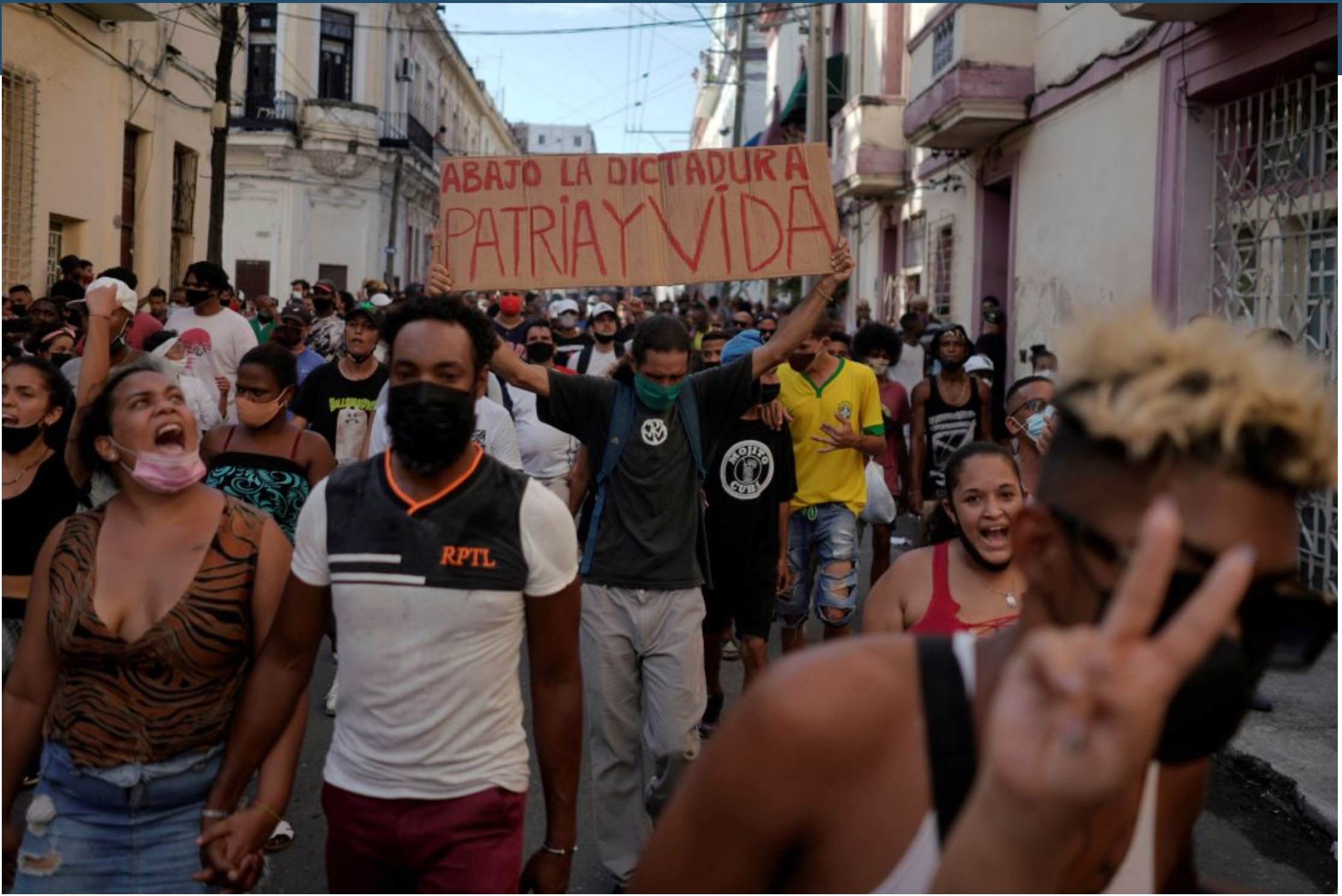
Over a million Cubans—nearly 10% of the population—have fled the island in the last two years alone. This is not a government; it is a prison warden who has run out of food. The moral legitimacy for intervention has been established with the recent largest uprising since the revolution, tens of thousands of Cubans took to the streets across the island, not merely demanding food, but chanting "Patria y Vida" (Homeland and Life)—a direct rejection of the regime's death cult slogan. The state’s response was not dialogue, but brutal repression and mass arrests. The Cuban people have already voted with their feet and their voices; they are not waiting for a savior, they are waiting for an ally to break the lock on their cell.
The United States can no longer afford to tolerate a failed state that doubles as a hostile intelligence platform. The strategy of "maximum pressure" through sanctions has weakened the regime, but it has not broken it. It is time to finish the job. The United States Navy and Coast Guard must implement a full naval quarantine of the island. Unlike the 1962 blockade, which was designed to stop missiles, this quarantine must be designed to stop the lifeline of the regime: oil, arms, and Chinese surveillance equipment. We must cut the cord. A physical blockade would force the collapse of the energy grid within weeks, grounding the military and paralyzing the security services that repress the population. The supply chain is already brittle; a naval cordon would snap it.
Critically, the United States possesses a unique strategic advantage that makes military action feasible without the casualties of a traditional invasion: Naval Station Guantanamo Bay (GTMO). This 45-square-mile sovereign foothold on the southeastern tip of the island fundamentally alters the operational calculus. GTMO eliminates the need for a dangerous "D-Day" style amphibious landing, providing a secure, pre-positioned deep-water port and airfield directly inside Cuban territory. It serves as an unsinkable aircraft carrier and a logistical hub for the naval quarantine fleet, protected by established defenses that the dilapidated Cuban military cannot hope to breach. Furthermore, its presence creates an immediate two-front dilemma for Havana. The regime cannot simply fortify the northern coast against an approach from Florida; it must also divert its dwindling resources to surround the American base in the southeast, stretching its lines to the breaking point. Guantanamo is not just a detention center; it is the ultimate staging ground for the liberation of the island.
Critics will inevitably raise the specter of the Bay of Pigs, the disastrous 1961 failed invasion. But this strategy bears no resemblance to that historical blunder. The Bay of Pigs relied on a small, lightly armed proxy force of exiles landing in a swamp without air support, hoping to incite a spontaneous uprising against a still-popular revolution. The "Island Trap" strategy relies on the overwhelming, direct application of U.S. naval and air superiority, staged from a secure base already on the island, against a regime that has lost all popular support and military cohesion. We are not asking exiles to storm the beach; we are utilizing the full might of the US armed forces to enforce international security.
Simultaneously, the United States must explicitly declare that the removal of the Cuban Communist Party leadership is a national security objective. We must abandon the fantasy that we can "negotiate" a transition with the successors of the Castros. Men like Miguel Díaz-Canel and Alejandro Castro Espín are not reformers; they are the trustees of a criminal enterprise. They have proven that they will starve their own people to protect their power and that they will sell their country’s strategic location to any enemy of the United States. The removal of this leadership requires the targeted application of American power to sever their communications, freeze their assets, and physically isolate them from their command structures or remove them from the island. We must support the Cuban people—not with speeches, but with the removal of their jailers. The Cuban military, largely conscripted and equally hungry, is unlikely to fight for a leadership that cannot pay them or feed them. By cutting off external resource flows, we force the internal collapse of the dictatorship.
The removal of the regime is not a plunge into chaos, but a prelude to a renaissance. Unlike other failed states, Cuba possesses a unique asset for rapid reconstruction: the highly educated, capital-rich Cuban-American diaspora just ninety miles away. A transition government, backed by U.S. security guarantees, would see an immediate influx of investment, expertise, and tourism, jumpstarting the economy overnight. The "Day After" in Havana does not look like Baghdad; it looks like a reunion of loved ones, one of whom has been lost in the wilderness, their very survival at risk, but who has been rescued.
Critics will argue that this is aggressive and violates sovereignty. But sovereignty implies a responsibility to one’s own people. A regime that drives its population into the sea, amasses great personal wealth while its population starves, and hosts nuclear submarines and foreign spy bases has forfeited its sovereign protections. The 60-year experiment is over. The infrastructure is ruined, the economy is dead, the government is a proxy for global conflict, and the people are desperate. We must act now to cut the cancer out of the Caribbean.
Darrell Lee is the founder and editor of The Long Views, he has written two science fiction novels exploring themes of technological influence, science and religion, historical patterns, and the future of society. His essays draw on these long-standing interests and apply a similar analytical lens to politics, literature, art, culture, and historical events. After retiring from a 36-year career as a software and systems engineer on the Space Shuttle and then the Space Station programs, he now splits his time between rural east Texas and Florida’s west coast, where he spends his days performing variable star photometry, dabbling in astrophotography, hunting, thinking, napping, fishing, scuba diving, and writing, not necessarily in that order. He is a member of the American Astronomical Society, American Radio Relay League, the American Association of Variable Star Observers, and the US Chess Federation.