A Demon of the Physical World
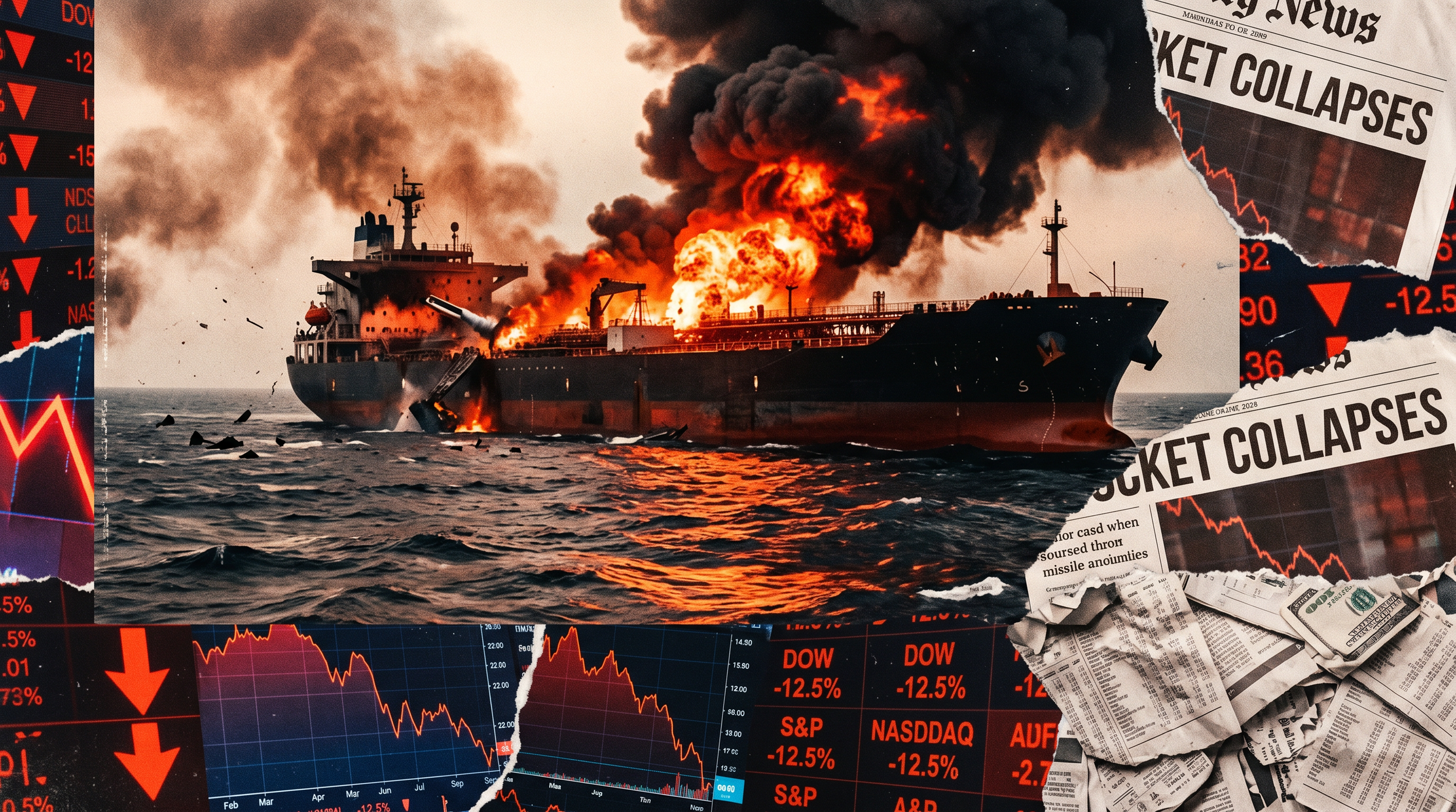
In aerospace engineering, we have a specific terminology for catastrophic failure. A "complex" system has many interacting parts that can fail in ways the designers never anticipated. In a "tightly coupled" system, there is no slack; a failure in one component instantly triggers the next failure, preventing human operators from intervening before the whole machine tears itself apart. For the last century, our global financial markets have been engineered with the same dangerous combination of complexity and tight coupling that drives catastrophic failure—creating a system primed for disaster.
The Great Crash of 1929 and the Global Financial Crisis of 2008 each revealed escalating systemic fragility. Today, however, the threat is even more severe: in March 2026, the tight coupling once limited to digital financial systems now connects directly to the physical world. We are not simply repeating past mistakes; we are compounding them, fusing digital and physical vulnerabilities. To understand the precipice we stand on, we must examine the architectural flaws of the past. The 1929 crash was a crisis of retail leverage and psychological exuberance. In the roaring twenties, margin debt was the structural flaw. Every day, Americans and holding companies borrowed massive sums to buy stocks. This was fueled by the ticker tape's accelerating speed. The system was tightly coupled by debt, but the complexity was relatively low. When the market dipped, margin calls forced some market participants to sell. That drove prices lower, triggering more margin calls and prompting others to sell. It was a brutal, straightforward feedback loop of liquidation that destroyed the banks and shattered the real economy.
Seventy-nine years later, the architecture of collapse had evolved. In his 2007 book, A Demon of Our Own Design, Wall Street risk manager Richard Bookstaber brilliantly diagnosed the impending 2008 crisis. He pointed out that financial innovation had outpaced human comprehension. The 2008 crisis was not driven by simple margin loans; it was driven by financial engineering. Wall Street engineered Collateralized Debt Obligations and Credit Default Swaps atop the housing bubble. These financial instruments created a complex, tightly coupled network—risks were so intertwined that no bank could assess its counterparties' holdings. When mortgage defaults began, the complexity masked growing risk, while the tight coupling ensured the collapse of Lehman Brothers, which instantaneously froze global credit. Tools designed to hedge risk instead amplified systemic vulnerability.
This brings us to the spring of 2026. But today, the danger is no longer financial engineering. As Bookstaber recently warned in an op-ed for The Wall Street Journal, the financial system has become entangled with the vulnerabilities of our physical world—power grids, supply chains, and contested geopolitical real estate. Now, we face a new kind of risk. Today, instead of facing isolated risks, we confront a single, volatile structure in which three major threats— the $2 trillion opaque private credit market, the massive concentration from the Artificial Intelligence boom, and the kinetic dangers of global warfare—have fused. It is their combined interaction, not just their coexistence, that amplifies systemic danger. Over the past two decades, post-2008 regulations forced traditional banks to retreat from risky lending. Nature abhors a vacuum, and the "private credit" industry—dominated by institutional investors and firms Blue Owl, BlackRock, and Blackstone—stepped in. Today, it is a $2 trillion shadow banking system. Unlike public bonds, these loans rarely change hands. There is no organized exchange. This creates a terrifying lack of price discovery and liquidity. Investors have no idea what these instruments are actually worth until conditions deteriorate, at which point an investor withdrawal can trigger a wholesale run.
At the same time, a second pillar of risk dominates. The stock market has been entirely consumed by the AI boom. The exuberance surrounding artificial intelligence has inflated the valuations of a handful of tech behemoths—Microsoft, Google, and Nvidia—to the point that just 10 stocks now account for more than a third of the S&P 500’s total value. This level of concentration is unprecedented. A shock to any of these companies will not be absorbed by the broader market; it will capsize the market. If the risks were only the usual financial dangers of a tech bubble and illiquid credit market, the system could face a standard crisis. But what makes the current threat far greater is the system's integration with the real, physical world. AI is not just software; it is a ravenous consumer of the physical world. It requires massive, billion-dollar data centers. Those data centers require highly advanced semiconductors, primarily manufactured in Taiwan. And they require staggering amounts of electricity. How are these massive data centers and infrastructure projects being funded? Largely through the opaque, $2 trillion private credit market.
Now, introduce the geopolitical shocks of 2026. As the United States and Israel execute "Operation Epic Fury" against Iran, the Iranian regime has retaliated by weaponizing the Strait of Hormuz. Drone swarms have struck Gulf energy infrastructure, sending global oil prices soaring past $100 a barrel. This is an immediate, physical energy shock. It constrains power supply and raises electricity costs globally. So far, the rise in oil prices hasn’t been high enough to affect the stock market, but this war is only months old. If the war should take an unforeseen turn, say China or Russia steps in to directly support Iran with the hi-tech weapon systems to alter the balance of the conflict so that it is no longer the “cake-walk” and a conflict that will be resolved quickly, as the Trump administration frames it to be. Turning Iran into the US’s version of Ukraine, with no end in sight, now a long-term stranglehold on 20% of the world’s oil supply is in play. Or Iran uses a nuclear material-infused dirty bomb to attack an Israeli city. Or a US warship protecting the Strait of Hormuz.
Things would change quickly.
In our tightly coupled system, this physical shock propagates instantly. If a sudden energy spike doubles operating costs for AI data centers, and simultaneously, the persistent threat of a Chinese blockade of Taiwan hangs over the semiconductor supply chain. Then, the physical infrastructure of AI falters due to energy costs and chip shortages; suddenly, due to changes in the physical world, the tech Goliaths weaken. When those tech companies weaken, the private credit loans backing their infrastructure begin to sour. Investors, sensing the shift, are withdrawing their money from private credit funds. But because private credit is illiquid, the fund managers cannot easily sell those loans to raise cash. What does a desperate investor do when they cannot sell what they want to sell? They sell what they can. To meet the margin calls and withdrawal requests of the private credit crunch, institutional investors will be forced to liquidate their highly liquid, publicly traded tech stocks. The massive, concentrated sell-off of those top 10 tech stocks will shatter the S&P 500.
Let’s consider a scenario, not the nightmare of 1929, when some stocks trading for hundreds of dollars were reduced to $2-$3 in a matter of days. What if the top ten tech stocks were reduced in value by 50% through cascading liquidation? The long-term effects would still cause the systemic damage of 1929 and 2008. Financial crashes never stay confined to Wall Street; they always reshape the geopolitical order. The 1929 crash destroyed the global credit system, leading directly to the Great Depression and breeding the economic desperation in Europe that ultimately paved the way for World War II. Similarly, the 2008 financial crisis triggered the Great Recession, fundamentally altering global politics and giving rise to the populist movements of the 2010s. The fallout from a 2026 tech crash—driven by this new, physical tight coupling—would unfold across five similarly devastating vectors. First, we would witness the evaporation of the American pension and retirement system. Because of the massive shift toward passive index fund investing over the last two decades, almost every 401(k), IRA, and state pension fund is disproportionately weighted in these specific tech behemoths. A 50% haircut to just these 10 companies would instantly vaporize trillions of dollars in household wealth, forcing a severe contraction in consumer spending and a prolonged recession.
Second, the private credit "death spiral" would accelerate. As tech valuations plummet, the $2 trillion shadow banking system would freeze. Institutional investors would panic, causing a run on illiquid private credit funds. Because these funds cannot easily sell their underlying loans, companies reliant on this debt to survive would default, triggering mass layoffs far outside the tech sector.
Third, the global economy would enter an innovation winter and infrastructure halt. The build-out of AI, data centers, and semiconductor foundries is incredibly capital-intensive. If the companies driving this boom lose half their value, their cost of capital skyrockets. The construction of physical tech infrastructure would grind to a halt, leaving half-built data centers empty and slashing orders for advanced microchips, sending shockwaves through the global supply chain.
Fourth, this financial paralysis would trigger a geopolitical power shift. The AI, computing, robotic, and semiconductor race is the defining geopolitical contest of the 21st century. If the U.S. tech sector devalues, it opens a massive window for China to seize global dominance in artificial intelligence and quantum computing. A financially crippled U.S. might also lack the economic leverage and domestic political will to defend Taiwan, fundamentally altering the balance of power in the Pacific.
Finally, the crash would lead to severe political and regulatory upheaval. Just as 1929 brought the New Deal and 2008 brought Dodd-Frank, a massive tech crash would trigger a political reckoning. The public backlash against the concentration of wealth in Silicon Valley and the opacity of shadow banking would be intense, likely leading to aggressive antitrust legislation to break up remaining tech monopolies and a populist demand for government intervention. This is the cascading failure Bookstaber warned of: not isolated crises, but multiple interlinked shocks—war, blockades, shadow banks, and a tech market boom—feeding a single, underlying, tightly coupled structure.
In 1929, the Federal Reserve could have saved the system by injecting liquidity into the banks. In 2008, the U.S. Treasury saved the system by bailing out the financial institutions and effectively nationalizing the toxic debt. But our modern risk models are built to read prices, volatility, and correlations. They have no instruments for reading a massive targeted strike on an oil refinery infrastructure in a Middle Eastern country, a severed undersea cable, or a naval blockade in the Pacific. By the time the warning signs appear in market data, the physical damage will already have been done. You cannot print a semiconductor. You cannot use quantitative easing to magically generate a gigawatt of electricity. And you cannot bail out a supply chain severed by a constant swarm of kamikaze drones or a single dirty bomb.
We have spent decades optimizing our financial system for efficiency and leverage, stripping away every buffer in pursuit of returns. Now, our blind faith in the stability of the physical world is colliding with reality. As the physical world unravels, the tightly coupled financial system faces risks that go far beyond anything we have engineered before.
Darrell Lee is the founder and editor of The Long Views, he has written two science fiction novels exploring themes of technological influence, science and religion, historical patterns, and the future of society. His essays draw on these long-standing interests and apply a similar analytical lens to politics, literature, art, culture, and historical events. After retiring from a 36-year career as a software and systems engineer on the Space Shuttle and then the Space Station programs, he now splits his time between rural east Texas and Florida’s west coast, where he spends his days performing variable star photometry, dabbling in astrophotography, hunting, thinking, napping, fishing, scuba diving, and writing, not necessarily in that order. He is a member of the American Astronomical Society, American Radio Relay League, and the American Association of Variable Star Observers.